
Every growing United States B2B company arrives at a structural crossroad when updating its digital infrastructure. You need to deploy a high-performance web application, overhaul an existing platform, or scale your organic lead acquisition channels. Immediately, the operational dilemma shifts to resource allocation. Do you contract a solo freelance web developer to keep upfront labor fees low, or do you retain an integrated agency team to manage the entire deployment ecosystem?
The decision is frequently framed as a simple budget comparison. Marketplace platforms pitch freelance hourly rates as the most efficient path to launch, while traditional corporate agencies justify massive retainers through ambiguous branding promises. Both models present hidden financial realities. If you miscalculate your project needs, choosing the wrong path can lead to missed deadlines, unoptimized search visibility, and fragmented codebases.
To make a smart choice, you need to understand the structural breaking point where independent contracting ceases to be profitable and integrated technical management becomes a financial necessity.
1. The True Cost of Labor: Upfront Rates vs. Internal Management Overhead
When you look at a freelancer’s hourly rate, it looks like a bargain. You are only paying for raw production hours. However, this line-item pricing hides a massive operational tax: your own time.
An independent freelance developer operates inside a strict technical silo. If you hire a front-end specialist to build a custom application interface using React or Tailwind CSS, that specialist is not responsible for your database design, API integrations, graphic asset production, or search engine layout strategy.
When you hire a single developer, you automatically step into the role of technical project manager. You must write the product requirement documents, coordinate asset handoffs, test the code for functionality, and ensure the deployment meets security compliance protocols. If you spend 10 to 15 hours every week fixing communication gaps between a siloed contractor and your marketing team, your true cost of labor skyrockets.
An integrated agency eliminates this internal management tax. The entry point to a professional firm includes a dedicated technical operations manager who synchronizes developers, designers, and search architects. Your internal leadership team interacts with a single workflow dashboard rather than debugging fragmented code branches across multiple communication channels.
2. Technical Debt and Single-Point-of-Failure Vulnerabilities
Software engineering requires strict version control, thorough documentation, and clean architecture standardizations. A major operational drawback of relying on a freelancer is the risk of a single point of failure. If your solo contractor shifts priorities, faces personal emergencies, or walks away from your account, your entire corporate digital asset stalls.
Furthermore, solo builders often introduce technical debt to hit speed targets. When developers rush production without peer code reviews, they frequently build brittle dependencies, rely on poorly maintained third-party modules, or write unoptimized database queries.
Over time, this technical debt degrades your performance metrics. According to W3C Web Design and Applications standards , clean code validation is a foundational requirement for stable, cross-browser web operations. Brittle code might work under light testing, but it quickly breaks when you attempt to implement new APIs or scale user concurrency.
A multi-disciplinary agency mitigates this risk through structural redundancy. For example, our 8-person global deployment ecosystem utilizes standardized peer-review workflows on every code repository. If a primary developer is unavailable, another cross-functional engineer steps in immediately without a loss of context. This technical continuity protects your source code from becoming a black box that no one else can read or maintain.
3. The Performance Gap: Core Web Vitals and Modern Search Engineering
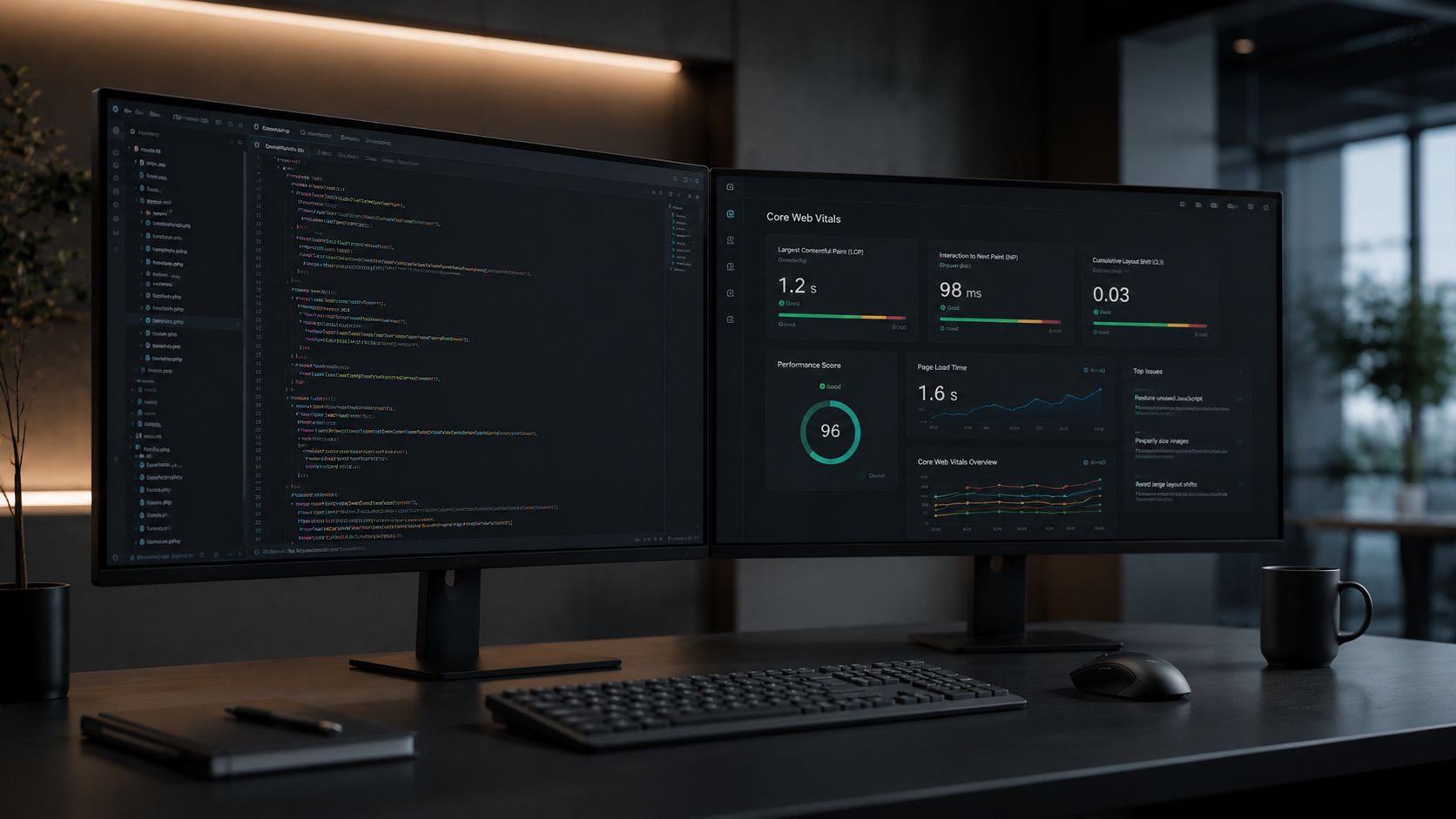
Your web architecture is the foundation of your digital market share. A common issue with low-cost freelance builds is an over-reliance on pre-built software packages, unoptimized page builders, and heavy script frameworks. These shortcuts break your site performance metrics and lower your search visibility.
Google explicitly treats page speed and user experience as core ranking indicators. As detailed in the Google Search Central Blog on Core Web Vitals, structural metrics like Largest Contentful Paint (LCP), First Input Delay (FID), and Cumulative Layout Shift (CLS) directly affect your placement in search engine results pages.
| Performance Indicator | Pre-Made Freelance Setup | Custom Agency Architecture |
| Code Base Optimization | Heavy script bloat, uncompressed assets | Tree-shaken JS, clean Tailwind/CSS |
| Largest Contentful Paint (LCP) | Usually exceeds 4.5 seconds | Engineered to stay under 2.5 seconds |
| Cumulative Layout Shift (CLS) | High instability from unconfigured elements | Zero structural shifting during asset load |
| Search Engine Readiness | Requires secondary technical SEO auditing | Built directly into the core code layout |
Freelancers working without a dedicated search strategist often deliver code that fails these performance checks. They may supply a visually appealing layout that suffers from severe rendering delays, render-blocking JavaScript, and uncompressed media elements.
At BetaTech, we approach web development through a performance-first lens. Our search managers work alongside our development team from day one. Whether deploying a custom Laravel platform or setting up a clean Next.js application, we engineer the site architecture to meet top speed requirements out of the box. We minimize HTTP requests, set up server-side rendering, and configure automated asset caching to ensure your pages load fast and rank well.
4. The ROI Breaking Point: Metrics That Dictate Your Choice
To choose between a full-service agency vs freelancer, you need to look at concrete business numbers. You can calculate the exact breaking point for your organization by analyzing three key operational metrics:
Metric A: Total Project Engineering Hours
If your digital requirements are limited to basic theme configuration or creating static landing pages, a freelancer is often highly cost-effective. However, when your scope of work expands past 80 hours of development time—requiring specialized user authorization workflows, database scaling, or complex payment processing connections—the project has outgrown a single contractor. It now demands the multi-layered skillset of a full engineering team.
Metric B: Cross-Disciplinary Dependencies
Track how many unique specialties your project requires. If you need a custom interface design, advanced database construction, professional copywriting, and technical search optimization, hiring separate freelancers creates major communication bottlenecks.
According to research published in the Harvard Business Review on Team Collaboration ), managing fragmented virtual teams without central systems drastically increases project failure rates. An agency provides a pre-synchronized team, eliminating these friction points.
Metric C: The Cost of Operational Downtime
Calculate what a platform outage or a broken lead form costs your company. If your website is your main sales channel, an afternoon of downtime can mean thousands of dollars in lost revenue. A solo freelancer cannot offer around-the-clock site monitoring or immediate emergency troubleshooting.
Transitioning your project to an agency becomes financially beneficial the moment your potential downtime losses exceed the cost of an agency retainer.
5. Security Protocols and Technical Standards Compliance
Cybersecurity threats present a major operational challenge for modern web systems. Independent builders regularly overlook advanced server hardening, SQL injection defenses, and strict Content Security Policies (CSP) because they are focused entirely on front-end visual delivery.
Leaving your customer data vulnerable can lead to significant financial liabilities. Enterprise digital applications must comply with strict global safety regulations. As outlined in the MDN Web Docs Security Guide, proper security requires explicit cookie management, transport-layer validation, and defensive header configurations.
DATA INFRASTRUCTURE SECURE LAYER
[User Browser] ──> Encrypted HTTPS ──> [Hardened CSP / Security Headers] ──> [Protected Database API]
A full-service digital agency builds these protective layers directly into your deployment pipeline. Instead of retrofitting security fixes after a breach, web systems should be developed using secure development lifecycles. This includes setting up automated dependency scanning, generating strict cross-origin policies, and running thorough vulnerability validation before pushing any code live.
Frequently Asked Questions
What happens if my freelance developer vanishes mid-project?
This is one of the biggest operational risks of independent contracting. If your freelancer leaves, your internal team is often stuck with undocumented, half-finished code that is incredibly difficult for a new developer to decipher. You are usually forced to pay for an expensive code audit or rebuild parts of the system from scratch. An agency avoids this single point of failure by maintaining centralized code documentation, clear version control branches on GitHub, and a team of developers who can step in to keep your project moving forward.
How does BetaTech’s global team structure lower my operational costs?
Traditional United States web agencies carry massive corporate overhead from physical offices and bloated administrative teams, which drives up their hourly rates. BetaTech uses a smarter operational model. Our family of 8 cross-functional experts bridges Bangladesh and the United States, giving you access to 5 to 13 years of hyper-focused engineering and marketing experience.
Because of our global footprint, we run a continuous 24/7 development cycle. While your internal US team finishes their workday, our developers keep pushing clean code, running security optimization audits, and monitoring performance updates overnight. You get rapid build timelines and round-the-clock site support without paying standard, bloated agency overhead.
Can a freelancer optimize my site for modern AI Search Engines (GEO/AEO)?
AI engine visibility requires a deep understanding of semantic code architecture, technical schema integration, and server-side rendering. Most freelancers specialize in either visual layout design or basic backend coding, rarely both. They seldom have the advanced search expertise needed to format content databases for AI crawler extraction. An integrated agency blends search engine optimization directly into the development process, making sure your site structure is optimized for both human users and modern AI crawlers from day one.
Is custom web development pricing actually predictable with an agency?
Yes, because professional agencies work under structured, milestone-based master service agreements. While a freelancer’s estimate can easily spiral due to unexpected bugs or scope creep, an agency performs a thorough technical discovery phase before writing any code. We outline all system requirements, API integrations, and asset dependencies upfront, giving you clear, predictable pricing tied directly to verifiable project milestones.
The Final Blueprint: Partner with BetaTech
Choosing between a full-service agency vs freelancer shouldn’t be a guessing game. It comes down to evaluating the complexity of your technology stack, protecting your business from operational downtime, and avoiding technical code debt.
At BetaTech, we skip the corporate fluff and focus entirely on delivering measurable technical performance. Our agile team of 8 cross-functional experts—including our founder Adnan Shawkat, operations director Miraj Ahmed, and senior system architect Sharmin Salma Tisha—handles every phase of your project under one roof. We don’t build generic layouts or rely on unstable templates that slow down your load speeds and put your data security at risk. We build fast, reliable web platforms tailored specifically to your conversion goals and engineered to pass Google’s performance standards.
Our global team structure gives you the ultimate operational advantage: an ongoing, 24/7 development cycle. We keep your project moving forward around the clock, providing rapid turnarounds, continuous security monitoring, and direct access to senior engineers without the typical high costs of a US agency. Let’s eliminate your technical hurdles and build a high-performance web asset you can trust.
Schedule a Strategy Session with Our Team Today to map out your custom project roadmap.