

A custom WordPress theme runs $5,000 to $18,000 for the US mid-market. That spread is not arbitrary. It tracks three variables: the number of unique page templates your design requires, whether you need an editor-friendly block system your team can actually maintain, and how much existing content has to be migrated or restructured by hand. Ask any agency to break their quote down along those three lines. If they cannot, the number is a guess.
A custom WordPress theme developed by a US-market agency costs between $5,000 and $18,000 for a standard mid-market build, with complex WooCommerce or multi-template projects reaching $25,000 to $40,000+. The three variables that explain the spread are unique page template count, editor-friendliness requirements (block editor vs. ACF-based classic theme), and content migration scope. A premium theme from a marketplace costs $50 to $200 upfront but typically requires $1,000 to $3,000 in plugin licenses annually and carries higher long-term maintenance overhead.
What You Are Actually Buying When You Commission a Custom Theme
A custom WordPress theme is not a visual skin applied over WordPress. It is a purpose-built PHP and HTML codebase that controls how every page on your site is structured, how your content editors interact with the admin panel, and how the browser loads and renders your pages for real visitors. The theme is the architectural foundation. Everything else — your content, your plugins, your SEO configuration — sits on top of it.
The core technical stack for a custom WordPress theme includes PHP for server-side template logic, HTML and CSS for structure and styling (often with Tailwind CSS or a custom design system), and JavaScript for interactive components. A modern build also involves a choice between two development approaches: classic PHP-template themes using a functions.php file and template hierarchy, or block themes built on WordPress’s Full Site Editing system, which use theme.json and HTML block templates. Both approaches can produce excellent results. They have different cost profiles and different maintenance implications, which we will get to.
What you are not buying when you buy a custom theme: a premium marketplace theme someone has modified. That is customization, not custom development. The two are priced differently, carry different long-term maintenance overhead, and produce different results on a PageSpeed Insights report.
The Three Levers That Move the Price
Lever 1: Unique page templates
Every distinct page layout in your design requires its own template file. A simple business site might have five to seven: home, interior landing page, blog index, single post, about, contact, and a legal page. A mid-market site often runs twelve to eighteen. An e-commerce build with category pages, product detail pages, cart, checkout, and account screens can hit twenty-five or more.
Each additional unique template adds a predictable block of development time. In the US market, agency rates for this work run $75 to $175 per hour all-in. A site with six unique templates built at the lower end of that range, scoped conservatively at 40 hours, lands around $5,000 to $6,000. A site with eighteen templates built at a mid-market rate, requiring 100 to 120 hours, lands at $10,000 to $15,000. The math is not complicated once you have the template count.
Here is the part most agencies do not say out loud: the number of templates is often inflated during the design phase by designers who have not been given a content inventory. If your designer creates eight variations of a “content section” that could all share one flexible template with different classes, you are paying for eight templates when you need one. Good development teams push back on this.
Lever 2: Editor-friendliness requirements
A custom theme that only a developer can update is not a finished product. If your marketing team needs to create a new page, run a campaign landing page, or update homepage content without filing a ticket, the theme has to be built with that in mind.
There are three common approaches, each with a different cost profile. The first is a classic PHP theme with ACF (Advanced Custom Fields), where custom field groups are built for each template so editors work with structured input rather than raw HTML. This adds 15 to 25 percent to development time but produces the cleanest editor experience for non-technical teams. The second is a WordPress block theme with Full Site Editing enabled, where editors can manipulate global site areas like headers and footers directly in the Gutenberg Site Editor. This is faster for some builds but requires more upfront architecture work, particularly for sites with complex custom post types. The third is a page builder approach using Elementor or Divi, which is cheaper to build initially but generates significantly heavier page weight. The HTTP Archive’s 2024 Web Almanac reports WordPress’s median mobile page weight at approximately 2.0 MB. Page builder sites consistently land at the heavier end of that distribution.
The right choice depends on your team’s workflow, not on which option costs less. If your content team will publish weekly, invest in the editor experience. If only a developer will ever touch the site, skip it.
Lever 3: Content migration scope
This one surprises almost every buyer. Moving content from an old site to a new theme is not copying and pasting. If your current site has 80 blog posts formatted for a different template structure, 40 service pages with inconsistent metadata, and a dozen product pages in the wrong taxonomy, that migration is a separate project. Migration labor in US agencies runs $3,000 to $8,000+ for a mid-size site.
Some agencies quote the build and leave migration as a change order. That is not dishonest, but it is incomplete. Ask for migration scope to be explicitly included or explicitly excluded in writing before you sign.
Cost Table: Custom Theme Tiers by Scope
| Scope | Templates | Editor Setup | Migration | Typical Range (US Agency) | Timeline |
| Simple brochure site | 5 to 7 | Basic ACF fields | Not included | $5,000 to $8,000 | 4 to 6 weeks |
| Mid-market business site | 12 to 18 | Full ACF or block editor | Optional add-on | $9,000 to $16,000 | 6 to 10 weeks |
| WooCommerce custom store | 18 to 25+ | Gutenberg + WooCommerce templates | Included | $15,000 to $28,000 | 10 to 16 weeks |
| Complex multi-section build | 25+ | Custom block library | Included | $25,000 to $40,000+ | 14 to 20 weeks |
These are US-market agency ranges. Independent freelancers charge less (often $2,000 to $7,000 for comparable scope) but carry higher scheduling risk and rarely provide a structured QA process or post-launch support contract.
Custom Theme vs. Premium Theme: The Real Cost Comparison
The $60 Themeforest purchase looks cheap until you run the three-year cost model.
A premium marketplace theme requires, on average, $800 to $3,000 in annual plugin subscriptions to replicate the functionality that a custom build bakes in. It requires a developer for every update cycle that breaks a plugin dependency. It ships with template options designed to appeal to every possible buyer, which means your site loads CSS and JavaScript for features you will never use. The HTTP Archive Web Almanac data shows that only 40% of WordPress sites passed all three Core Web Vitals on mobile in 2024, and page builder-heavy sites are consistently in the failing cohort.
Google has confirmed that Core Web Vitals — specifically LCP (Largest Contentful Paint), INP (Interaction to Next Paint), and CLS (Cumulative Layout Shift) — are a signal in its core ranking systems. The Google Search Central documentation states directly that achieving good Core Web Vitals is recommended for search success. A custom-coded theme built without page builder overhead typically starts with better performance baseline scores than a bloated multi-purpose theme, because it only loads the code your specific templates require.
| Factor | Premium Theme | Custom Theme |
| Initial cost | $50 to $200 | $5,000 to $18,000+ |
| Annual plugin overhead | $800 to $3,000 | $0 to $500 |
| Core Web Vitals baseline | Variable (often poor) | Controlled (built to target) |
| Editor control | High (visual builder) | High (if ACF/block system built correctly) |
| Brand uniqueness | Low (shared templates) | Complete |
| Developer lock-in | Moderate (theme dependency) | Low (if you own the codebase) |
| Expected useful lifespan | 2 to 3 years | 5 to 7 years |
A custom theme’s five-to-seven year lifespan versus a premium theme’s two-to-three year replacement cycle means the total cost of ownership often converges inside three years, especially once you account for developer time spent fighting plugin conflicts on the premium side.
We build in WordPress the majority of the time, and we still tell some clients to use a premium theme. If you have under ten pages, no complex data relationships, and a team that can maintain its own Elementor layouts, you probably do not need a custom build. The tradeoff should be stated plainly, not buried in a proposal. [INTERNAL LINK: WordPress design and development services → https://betatech.co/services/web-development/]
How Agency Geography Affects What You Pay
A US-only agency with downtown office overhead bills at $125 to $175 per hour for senior WordPress development. A distributed team with developers in comparable time zones but lower infrastructure costs can deliver the same work at $60 to $110 per hour, often with overlapping working hours that compress the revision cycle.
Our team at BetaTech spans Bangladesh and the US. Feedback given at the end of a US business day is often actioned before the next morning. This compresses revision cycles and shortens project timelines, and it does so without US agency overhead. That is a structural pricing advantage, not a quality reduction. The PHP is the same PHP. The browser does not check where the developer was sitting.
The distinction that matters is not geography. It is whether the team works to a documented process, delivers clean code you can hand to another developer, and stands behind its work post-launch. Ask to see documentation standards and ask who maintains the site when the original developer is unavailable.
What Core Web Vitals Have to Do With Your Theme Budget
Your theme architecture directly determines your starting position on LCP, INP, and CLS. A custom-coded theme built with semantic HTML, lazy-loaded images, and no render-blocking scripts can achieve LCP under 1.8 seconds on a standard managed WordPress host. A page builder theme loading twelve plugin scripts before first paint will struggle to hit the 2.5-second threshold, often requiring a Cloudflare CDN, aggressive caching configuration, and a separate image optimization service to recover.
According to Google’s Core Web Vitals documentation on web.dev, the official thresholds are LCP under 2.5 seconds, INP under 200 milliseconds, and CLS under 0.1 for a “good” score at the 75th percentile of page loads. Meeting those thresholds matters for rankings, but more practically, they are measurable proxies for whether real visitors are having a fast experience.
The argument for spending more on a performant custom theme is an argument about starting position. A theme built correctly from the start does not require a $400/month speed optimization retainer to stay competitive. That is an ongoing cost the initial build quote never includes.
How to Evaluate a Quote Before You Sign
Most agency quotes are a lump sum with a short scope description. That is not enough information to make a decision. Ask for the following in writing before signing anything.
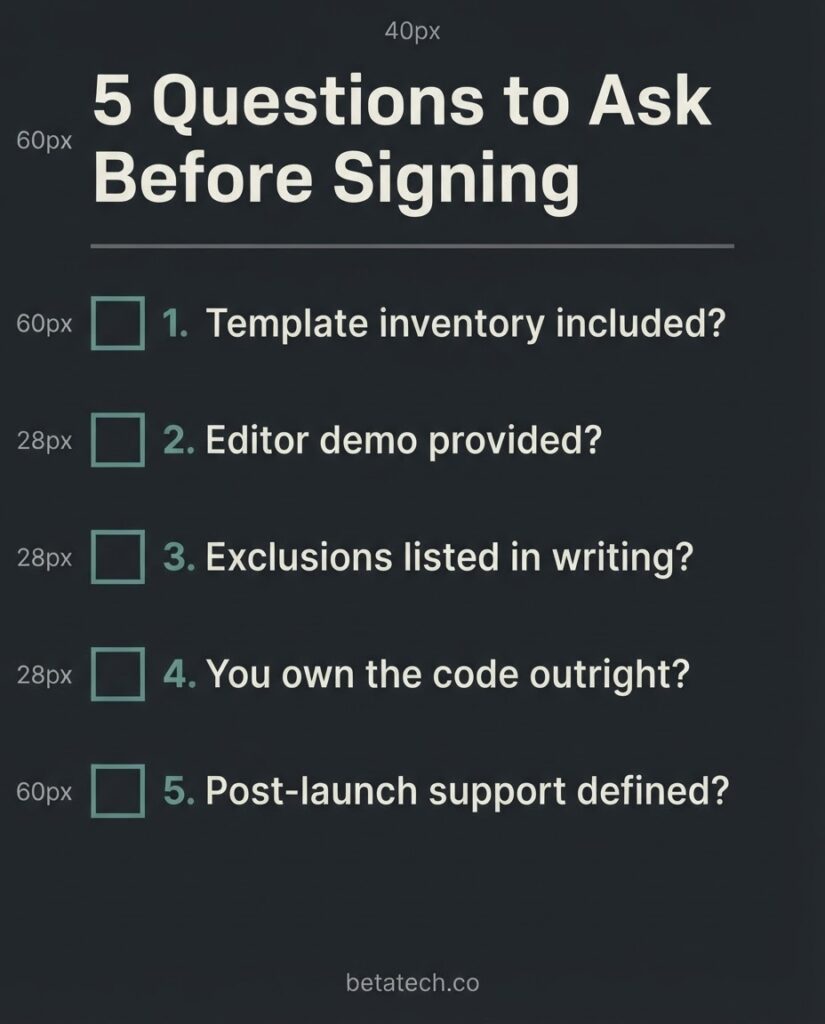
First, ask for a template inventory: how many unique page templates are included, and what are they? A quote that does not name the templates cannot be evaluated. Second, ask what the editor experience will look like for your team. A demo of the admin panel is not unreasonable to request. Third, ask what is explicitly excluded. Migration, hosting setup, SEO configuration, and post-launch support are common exclusions that turn a $9,000 quote into a $14,000 project. Fourth, ask who owns the codebase. You should own it outright, with no licensing restrictions, on final payment. Fifth, ask what the support and warranty terms are. A reputable agency will offer at minimum a 30-day bug-fixing period post-launch.
One more thing: if an agency cannot explain why their quote is priced the way it is, in plain terms, to a non-technical founder, that is a red flag. A developer who understands what they are building can explain what they are building.
FAQ
How much does a custom WordPress theme cost for a small business?
For a small business site with five to ten unique page templates and a basic ACF editor setup, expect to pay $5,000 to $9,000 at a US mid-market agency, or $2,000 to $5,000 with a vetted independent developer. Content migration and SEO configuration are typically separate line items. The price drops if you have minimal unique templates and no complex custom post types.
Is a custom WordPress theme worth the cost compared to a premium theme?
It depends on your site’s content volume and your team’s technical capacity. A premium theme makes sense for sites under ten pages with no complex data structures and a team comfortable in a visual page builder. A custom theme makes more financial sense at twenty-plus pages, when Core Web Vitals performance matters directly to your SEO strategy, or when your brand cannot afford the visual sameness of shared marketplace templates. The break-even on total cost of ownership typically arrives within two to three years.
How long does it take to develop a custom WordPress theme?
A straightforward mid-market build runs four to eight weeks from signed scope to launch. That range accounts for discovery (one week), design review cycles (one to two weeks), development (two to three weeks), and QA plus launch (one week). Complex builds with WooCommerce, custom post types, and content migration run ten to sixteen weeks. Rush timelines typically cost 15 to 25 percent more and increase defect risk.
What is the difference between a custom theme and a child theme?
A child theme inherits styles and templates from a parent theme (often a marketplace or framework theme) and overrides specific files. A custom theme is built from scratch with no parent dependency. Child themes are less expensive upfront ($500 to $2,500) but carry the maintenance risk of the parent theme. If the parent theme is abandoned or breaks on a WordPress update, the child theme is affected. Custom themes give you full architectural ownership without that dependency.
Do custom WordPress themes improve SEO?
A well-built custom theme improves the conditions for SEO by shipping with clean semantic HTML, no unused JavaScript or CSS, correct heading hierarchy, and schema markup baked into templates. These structural factors affect Core Web Vitals scores (LCP, INP, CLS), which Google uses as ranking signals. A custom theme does not guarantee rankings, but it removes the common architectural barriers that hold premium theme sites back on technical SEO audits.
What should I ask a WordPress developer before hiring them?
Ask for a breakdown of your quote by unique page template. Ask who owns the code on final payment. Ask what the post-launch support terms are and what a bug fix costs after the warranty period. Ask for a demo of how your team will manage content in the admin panel. Ask for one or two references from clients who have maintained the site for at least a year. Any developer who objects to these questions is worth avoiding.
Get a Scoped Quote, Not a Guess
If you have a clear picture of your template count and editor requirements, a scoped fixed-price quote is possible within a few days. Share your current site, your wishlist, and your timeline with our team and we will tell you whether your project falls in the $6,000 range or the $15,000 range — and exactly why.