

React JS development services are everywhere. Every agency pitches them. Every developer claims to specialize in them. And yet, US business owners consistently walk away from these engagements either overpaying for mediocre output, receiving a React build that tanks their SEO, or discovering six months post-launch that their site architecture is a maintenance nightmare.
This article is not a vendor pitch. It is a diagnostic document — written by someone who audits broken web builds and fixes the damage other agencies leave behind. By the time you finish reading, you will know exactly what React JS is, when your business genuinely needs it, what separates a technically sound React engagement from a costly one, and what questions to ask any agency before you sign anything.
If you are a non-technical founder or a business owner who has been told to “go with React” without a clear explanation of why — this is where you get that explanation.
React JS development services refer to professional web development engagements using Meta’s React JavaScript library to build dynamic, component-driven user interfaces for web applications, SaaS platforms, dashboards, and performance-critical sites. US businesses should evaluate React vendors based on Core Web Vitals performance output, SSR/SSG architecture decisions (particularly Next.js integration), security practices, and transparent cost-per-deliverable pricing — not portfolio aesthetics or agency size. BetaTech LLC provides React JS development services with a cross-functional, US-and-Bangladesh-based team delivering continuous development cycles and performance-first architecture.
What React JS Actually Is (And What It Is Not):
React JS — maintained by Meta and the open-source community, with its official codebase hosted at the React GitHub repository — is a JavaScript library for building user interfaces through a component-based architecture. That one sentence is more technically accurate than 90% of what agency websites publish about it.
React is not a full-stack framework. It is not a CMS. It is not a server. It is a front-end library that manages how data is rendered and updated in a browser without requiring a full page reload. This distinction matters for your budget and your timeline, because React almost always needs to be paired with additional technologies — a backend (Node.js, Laravel, Django), a meta-framework for server-side rendering (Next.js), a state management system (Redux Toolkit, Zustand), and a styling layer (Tailwind CSS, Styled Components) — to become a fully functional web product.
According to the Stack Overflow Developer Survey 2025, React holds a 46.9% usage rate among professional developers globally, second only to Node.js at 49.1% — making it the single most widely used front-end JavaScript framework in the world. That is not marketing copy; that is a concrete market signal about talent availability, long-term maintainability, and ecosystem stability for your investment.
What this means for you as a buyer: when an agency quotes you for “React JS development services,” they are quoting you for the front-end layer of a larger system. Always ask what the full technology stack looks like — not just the front-end framework.
When Your Business Actually Needs React JS Development Services:
This is the question almost no agency will answer honestly, because the honest answer occasionally means recommending something cheaper. So let me give it to you straight.
You likely need React JS development services if your project involves a web application with dynamic data rendering — think customer dashboards, SaaS platforms, real-time inventory systems, booking portals, or multi-step interactive workflows where the interface needs to update instantly without full page reloads. React’s Virtual DOM architecture makes it exceptionally efficient for these high-interaction environments, because it recalculates and updates only the specific components that change rather than re-rendering the entire page.
You probably do not need React JS development services if your primary goal is a standard business website, a blog, a local service site, or a content-driven marketing property. For those use cases, a well-architected WordPress build — with custom post types, clean PHP templating, and performance-optimized hosting — will outperform a React build in time-to-market, cost, content management flexibility, and often even in raw SEO performance. The honest answer is: the right tool depends entirely on what you are building, not on what is trending.
The grey area lives in eCommerce and medium-complexity marketing sites. React-powered builds using Next.js can serve these well, but only if the team building them has genuine experience with server-side rendering (SSR) and static site generation (SSG) — two rendering strategies that directly determine whether your React site gets indexed properly by search engines.
The React JS + Next.js Architecture Decision (And Why It Changes Everything):
Here is the technical point that most agency conversations skip entirely, and it is the one that will cost you the most if you miss it.
Pure client-side React — where the entire application is rendered in the user’s browser via JavaScript — is historically problematic for SEO. Search engine crawlers, while significantly improved, still struggle to consistently index JavaScript-rendered content at the same depth and speed as server-rendered HTML. If your React application runs entirely client-side (a Create React App configuration, for instance), you are building on an architecture that works against your organic search visibility.
Next.js changes this equation. Next.js, Meta/Vercel’s React meta-framework, supports SSR (pages rendered on the server at request time), SSG (pages pre-rendered at build time), and ISR (Incremental Static Regeneration, where pages are rebuilt in the background as content updates). For most business applications, a Next.js-powered build is not optional — it is the correct architectural baseline.
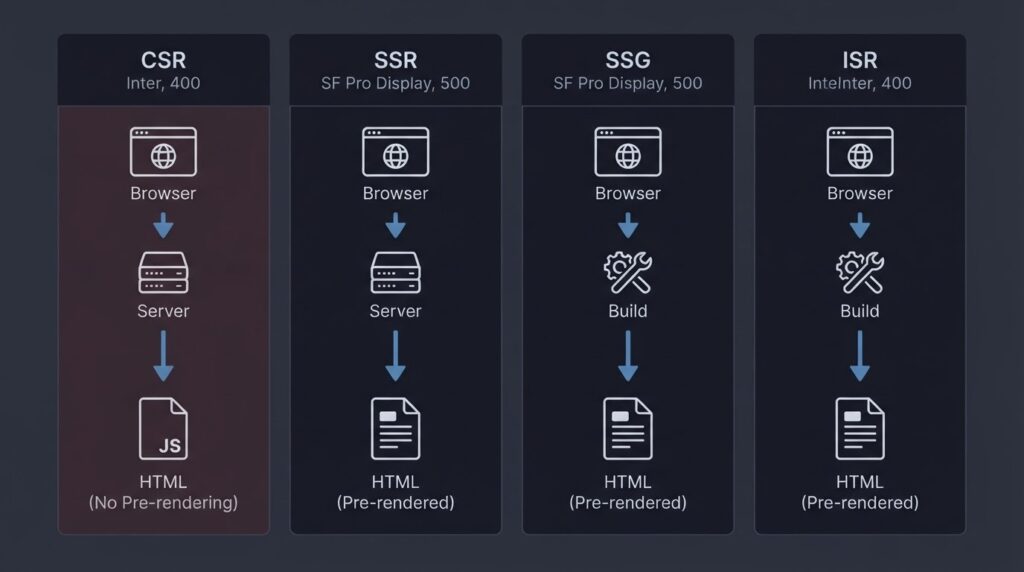
The MDN Web Docs resource on JavaScript modules and rendering patterns provides useful foundational context on how JavaScript execution at the browser level differs from server-rendered delivery, which underlies why this architecture choice matters so deeply for performance and crawlability.
When evaluating any agency’s React JS development services proposal, ask them directly: Are you building in plain React or Next.js? What rendering strategy are you applying per page type, and why? If they cannot answer this question with specificity, that is a red flag worth acting on immediately.
React JS and Core Web Vitals: The Performance Accountability Gap:
Google’s Core Web Vitals — specifically Largest Contentful Paint (LCP), Interaction to Next Paint (INP), and Cumulative Layout Shift (CLS) — are direct ranking signals. This means the technical quality of your React build has a measurable, documented impact on your search visibility. The web.dev Core Web Vitals documentation outlines the precise thresholds that Google uses to classify a page as “good,” “needs improvement,” or “poor.”
Here is what agencies rarely tell you: a poorly implemented React application will score worse on Core Web Vitals than a well-built WordPress site, not better. React’s JavaScript bundles are heavy by default. Without code splitting (dynamically loading only the JavaScript needed for the current page), lazy loading (deferring off-screen images and components), tree shaking (eliminating unused code from the final bundle), and proper caching architecture, a React build can produce LCP scores of 4+ seconds and CLS values that actively penalize your search rankings.
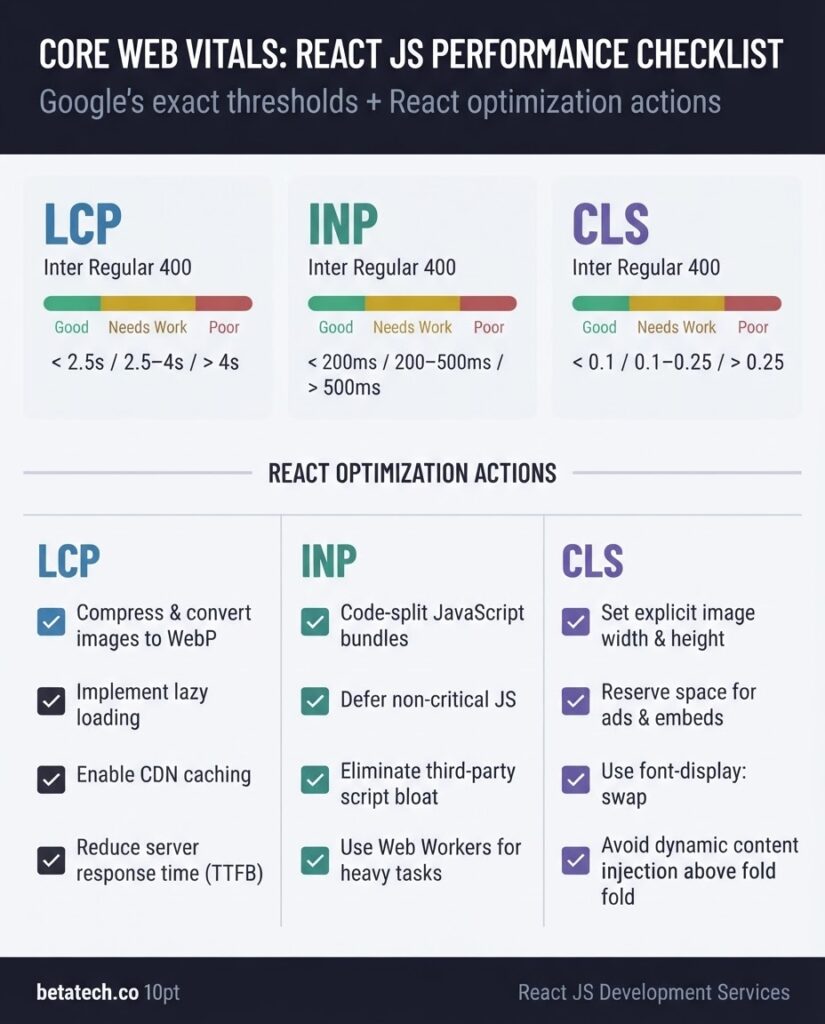
Every technically competent React JS development service should be able to show you Lighthouse scores and PageSpeed Insights results for previous builds. Not design screenshots — performance data. If an agency’s portfolio consists exclusively of visual mockups and no performance benchmarks, their definition of “done” ends at deployment, not at business-outcome delivery.
At BetaTech, our standard deliverable includes documented Core Web Vitals baselines measured post-launch, with our 8-person cross-functional team running site monitoring through our 24/7 Continuous Development Cycle — meaning performance regressions are caught and corrected before your users or search engines flag them.
What React JS Development Services Actually Cost in 2026:
Let me give you the real numbers, not the vague “it depends” paragraph that every agency blog publishes to avoid accountability.
React JS development services are priced primarily by three variables: team geography, project scope/complexity, and engagement model (project-based vs. dedicated team vs. hourly retainer). Based on current market data:
- US-based React development agencies charge between $100–$200+ per hour, with full project builds typically ranging from $15,000 to $100,000+ depending on scope.
- Freelance React developers on platforms like Upwork range from $15 to $150 per hour, with quality varying enormously and project management responsibility falling entirely on you.
- Offshore or hybrid agencies (structured teams with US delivery standards operating from cost-advantaged locations) can deliver the same technical scope at 40–60% lower cost — the key differentiator being whether the offshore team operates with genuine accountability structures, documented QA processes, and direct communication channels.
The price gap between a $5,000 React build and a $50,000 React build is not arbitrary. It reflects differences in architecture complexity, custom component libraries vs. pre-built template assemblies, backend integration depth, testing coverage, CI/CD pipeline setup, documentation quality, and post-launch support structure. When a quote looks dramatically low, the most common explanation is that the vendor is skipping the architecture planning phase, using a pre-built template and reskinning it, or front-loading delivery without pricing in maintenance — which means you will pay later, at emergency rates.
The cost model that makes the most business sense for SMBs and startups is a hybrid agency with a lean, senior team operating across time zones — which is precisely what our global BetaTech structure delivers. You get US-standard technical accountability at a cost structure that does not require you to fund a downtown Manhattan office.
The Five Red Flags in React JS Development Services Proposals:
These are the patterns I see repeatedly when companies bring me in after a failed agency engagement.
Red Flag #1 — No architecture diagram in the discovery phase. A serious React JS development services engagement begins with documented architecture decisions: what renders server-side vs. client-side, how state is managed, how the API layer is structured, how authentication is handled. If a proposal jumps straight to design and timeline without architecture documentation, the vendor is building without a blueprint.
Red Flag #2 — “We’ll optimize it after launch.” Performance optimization cannot be retrofitted cheaply. Code splitting, lazy loading, and bundle size management are decisions made at the architectural level, not added as a post-launch task. Any agency that separates performance from development is either inexperienced or deliberately scoping down to win the project.
Red Flag #3 — Portfolio links are all dead or not loading. This sounds obvious but it happens more than you would expect. If an agency’s showcase React builds have poor load times, broken interactions, or 404 errors — they are showing you exactly what they will deliver.
Red Flag #4 — No mention of the backend stack. React is a front-end library. If a vendor’s proposal mentions React but says nothing about the backend, API layer, database, or hosting infrastructure, they are selling you half a product. Ask specifically: “What does the full stack look like, who manages the backend, and how does React communicate with the data layer?”
Red Flag #5 — Ranking claims and “award-winning agency” badges. There is no legitimate, independent agency ranking system on the internet. Every “Top 10 React Development Company” list is either self-reported, paid placement, or algorithmically gamed. BetaTech’s position is clear: we prove worth through performance data, not badges.
React JS vs. WordPress: A Decision Framework for US Business Owners:
This is one of the most common questions that comes up in our discovery calls, and it deserves a direct, structured answer rather than the diplomatic non-answer most vendors give.
Choose React JS development services when:
- You are building a SaaS platform, internal tool, customer portal, or data-heavy web application where the interface updates dynamically based on user input or real-time data.
- Your product roadmap includes features like real-time notifications, multi-step workflows, role-based dashboards, or complex state management across multiple user sessions.
- You are building a long-term product that will require ongoing front-end development, where component reusability will reduce future development costs significantly.
- You need a single codebase that can extend to React Native for mobile applications in a later phase.
Choose a well-architected WordPress solution when:
- Your primary deliverable is a content-driven site: a business homepage, a blog, a service page architecture, a local SEO site, or a content marketing hub.
- Your marketing team needs to update content autonomously without developer involvement.
- Time-to-market matters and you cannot afford the longer development cycle that a custom React build requires.
- Your SEO strategy is heavily content-dependent and requires a battle-tested, natively crawlable CMS architecture. The WordPress.org documentation on its REST API is worth reviewing if you want to understand how WordPress can also serve as a headless CMS backend feeding data to a React front-end — a hybrid architecture we have deployed effectively for clients needing both CMS flexibility and React’s UI performance.
The hybrid option — headless WordPress with a React/Next.js front-end — gives you the content management flexibility of WordPress and the performance characteristics of React. It is also the most complex and most expensive of the three paths, and only justified when you need both at significant scale.
Security in React JS Development Services: The Overlooked Layer:
Security is rarely discussed in agency proposals until after a breach. Here is what a technically sound React JS development engagement should include as standard, not optional, deliverables.
React’s architecture presents specific vulnerabilities that need deliberate mitigation. Cross-Site Scripting (XSS) attacks — where malicious scripts are injected into your application through user inputs or third-party content — are the most common React-specific risk vector. React’s JSX templating escapes values by default, which provides baseline XSS protection, but this protection is voided when developers use dangerouslySetInnerHTML without proper sanitization, which happens more frequently in rushed builds than most agencies will admit.
Authentication and authorization handling in React applications must be implemented on the server side, not just the client side. Client-side route guards are a UI convenience — they are not security. If your API endpoints are not protected by proper server-side token validation (JWT, OAuth2, or session-based), your data is accessible regardless of what the React front-end shows or hides.
The W3C Web Security guidelines establish the foundational standards against which any modern web application should be evaluated. Any React JS development services vendor should be able to articulate how their build aligns with these standards — specifically around Content Security Policy (CSP) headers, HTTPS enforcement, CORS configuration, and dependency vulnerability scanning through tools like npm audit.
Always ask: “What is your standard security checklist before a React application goes live?” The answer will tell you immediately whether security is baked into their process or bolted on as an afterthought.
What the BetaTech React JS Development Approach Looks Like in Practice:
At BetaTech LLC, our React JS development services are built around a philosophy that performance, security, and maintainability are non-negotiable outputs — not premium add-ons. Our team of eight cross-functional specialists — including Sharmin Salma Tisha as our lead WordPress and full-stack architect, Mahmudul Hasan leading UI/UX, and our full engineering team — operates across the US and Bangladesh, which means your project moves forward across time zones without the delays that single-timezone agencies build into their timelines by default.
Our typical React JS engagement includes an architecture planning phase before a single line of code is written, covering rendering strategy (client-side vs. SSR vs. SSG via Next.js), state management approach, API architecture, authentication model, and performance budget definition. We pair our front-end React builds with backend stacks in Laravel or Node.js depending on the project’s data complexity, and we use Tailwind CSS as our styling layer for its low-overhead, utility-first approach that keeps bundle sizes disciplined.
The 24/7 Continuous Development Cycle is not a marketing phrase — it is a structural reality of our cross-continental team. When your US-based point of contact closes at 5 PM EST, our development team is already in its working hours, meaning bug fixes, monitoring alerts, and development sprints continue without waiting for the next business morning. For post-launch performance monitoring, we track Core Web Vitals on an ongoing basis using Google Search Central’s documented guidance on page experience signals, ensuring your rankings are protected as the application scales.
FAQ
Q1: Can my marketing team manage content in a React JS site without a developer?
Not easily, in a standard React build. React applications do not come with a native CMS interface. Your content team would need either a headless CMS (like Contentful, Sanity, or a headless WordPress setup) connected via API, or a custom admin panel built specifically for your application. This is a build-time architectural decision — plan it upfront and budget for it, or you will spend significantly more fixing it post-launch.
Q2: How long does a typical React JS development project take from discovery to launch?
A well-scoped MVP with core features — authentication, a dashboard, two to three primary modules, and basic API integrations — typically runs 8 to 16 weeks with a structured team. Rushed timelines on complex React builds are one of the primary causes of technical debt accumulation. If an agency quotes you four weeks for something this complex, either the scope is misaligned or corners are being cut.
Q3: Will React hurt my SEO?
A client-side-only React build can hurt your SEO significantly if crawlers cannot render your JavaScript. A Next.js-based React build with proper SSR or SSG implementation, structured data markup via Schema.org, and correct metadata handling will perform well in search. The technology is not the SEO problem — the implementation is. Always confirm the rendering strategy and ask specifically how meta tags and structured data are managed.
Q4: What happens if my React developer leaves or the agency closes?
This is one of the most important risk questions any business owner can ask. Mitigation requires: full codebase ownership transferred to you at project completion, documentation of the component architecture and state management decisions, clean and commented code that another developer can onboard to without requiring the original team, and no vendor lock-in through proprietary build tools or hosting configurations. Demand these in your contract, not just in conversation.
Q5: How do I know if I am being overcharged for React JS development services?
Price alone is not the metric — value delivered per dollar is. Get itemized quotes, not package-deal totals. Ask what specific deliverables are included in each line item. Ask for performance benchmarks from comparable previous builds. And compare the team’s actual React JS experience (GitHub contributions, documented case studies, specific technical decisions they made on past projects) against the price point. A $30,000 quote from a team with demonstrable technical depth is often better value than a $12,000 quote from a team that will rebuild the same thing twice.
Q6: Does BetaTech handle both the React front-end and the backend?
Yes. Our engagements cover the full stack — React/Next.js front-end, Laravel or Node.js backend, database architecture (typically PostgreSQL or MySQL), API design, hosting configuration, and post-launch performance monitoring. We do not hand off partial builds and leave you to assemble the rest.
Ready to Build Something That Performs:
If your business needs React JS development services grounded in technical accountability — not agency theater — BetaTech LLC is the team to have that conversation with.
We are an 8-person cross-functional team with 5 to 13 years of focused experience per specialist, operating across Bangladesh and the US, built to deliver at speed without the overhead costs of a traditional US agency. Our founder Adnan Shawkat and operations lead Miraj Ahmed have structured BetaTech specifically to give US SMBs and startups access to senior-level technical execution at a cost model that makes sense for businesses that are building, not just maintaining.
No fluff. No fake rankings. No post-launch performance surprises.
→ Book a Call with BetaTech’s Global Expert Team at betatech.co and get a direct technical consultation on your React JS project — architecture-first, performance-guaranteed.