

When a US business owner searches for react native development services, the search itself is rarely the hard part. Dozens of agencies will appear, each claiming to be “top-rated,” “award-winning,” or the “#1 React Native shop” in some self-curated ranking that exists nowhere verifiable. The actual challenge is sorting through the noise and knowing what legitimately matters before you hand over a budget and a deadline.
This article is not a sales pitch disguised as a guide. It is a direct, technical breakdown of what you need to verify — architecturally, contractually, and operationally — before committing to any agency offering react native development services. I’ll walk through the framework, the architecture decisions, the cost signals, the red flags, and the questions you should be asking on your first discovery call.
If you’re a non-technical founder or a marketing director tasked with evaluating mobile development vendors, read this from top to bottom. Every section answers a question your agency shortlist is hoping you won’t ask.
React native development services enable businesses to build iOS and Android apps from a single JavaScript codebase using Meta’s React Native framework, now running on its production-stable New Architecture (v0.76+) featuring JSI, Fabric, and TurboModules. Before hiring an agency, US business owners should verify architecture version compliance, code portability clauses in the contract, past app performance benchmarks, and whether the team actively maintains the app post-launch — not just delivers it. The key differentiator between agencies is not their pricing tier but their depth of technical accountability.
What React Native Development Services Actually Include
Most agencies lead with the headline benefit — one codebase, two platforms, faster delivery — and stop there. That pitch is technically accurate but operationally incomplete. Here is what a legitimate scope of react native development services should cover from day one.
App Architecture & Codebase Structuring
The foundational decision in any React Native project is how the codebase is organized. An agency that defaults to a flat file structure with no clear separation between business logic, UI components, and API calls is going to produce a codebase that becomes a maintenance burden within six months. Look for agencies that implement a layered architecture pattern — at minimum, a clear separation between presentation, domain, and data layers.
The framework itself now supports component-level code splitting, type-safe native module bindings through Codegen, and synchronous JavaScript-to-native calls via the JavaScript Interface (JSI) — none of which benefit you if your agency is still scaffolding projects using patterns from 2020.
New Architecture Compliance (Non-Negotiable in 2025+)
This is a hard technical checkpoint that most non-technical buyers never ask about, and agencies quietly exploit that gap. As of React Native 0.76, released in October 2024, the New Architecture — comprising JSI, Fabric renderer, and TurboModules — became the default and production-ready standard for all new projects, as officially documented on the React Native release blog.
If an agency is still building on the legacy bridge-based architecture in new projects started after late 2024, that is a direct signal they are either behind on the framework or deliberately cutting corners on setup complexity. The old asynchronous JavaScript bridge introduced latency between JS and native threads — a problem JSI eliminates by enabling direct, synchronous native calls without serialization overhead.
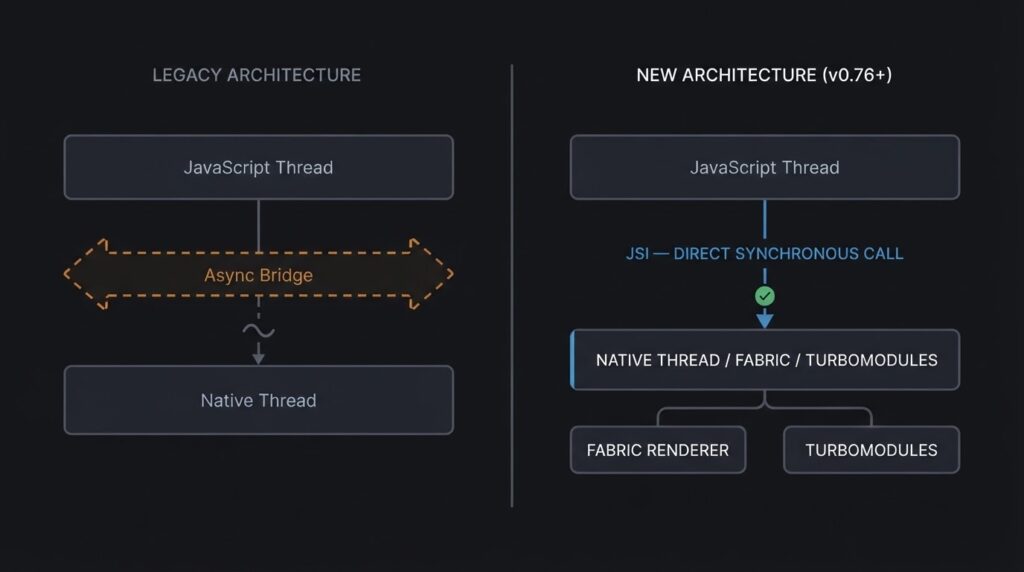
Fabric, the new UI rendering engine, provides synchronous layout calculations and concurrent rendering support aligned with React 18.
Ask your vendor explicitly: “Are you building on React Native’s New Architecture by default? How do you handle TurboModules for native API access?” A blank stare or a generic response is disqualifying.
Platform-Specific Code Handling
The “write once, run anywhere” narrative is marketing shorthand that obscures a real technical reality: some platform-specific behaviors require native module customization. Push notifications, biometric authentication, background processing, and deep-link handling all behave differently on iOS and Android at the native layer. A capable agency builds clean abstraction wrappers using Turbo Native Modules so your JavaScript-layer code doesn’t become a mess of Platform.OS === ‘ios’ conditional branches scattered across hundreds of files.
React Native development services that ignore this detail will produce an app that works in the demo environment and starts fragmenting in production as edge cases across device manufacturers surface.
The Framework Decision: React Native vs. Flutter in Plain Terms
This is the question that consumes weeks of decision-making for US founders, and rightfully so — it is a long-term architectural commitment. Here is a direct, non-tribal breakdown.
When React Native Is the Right Call
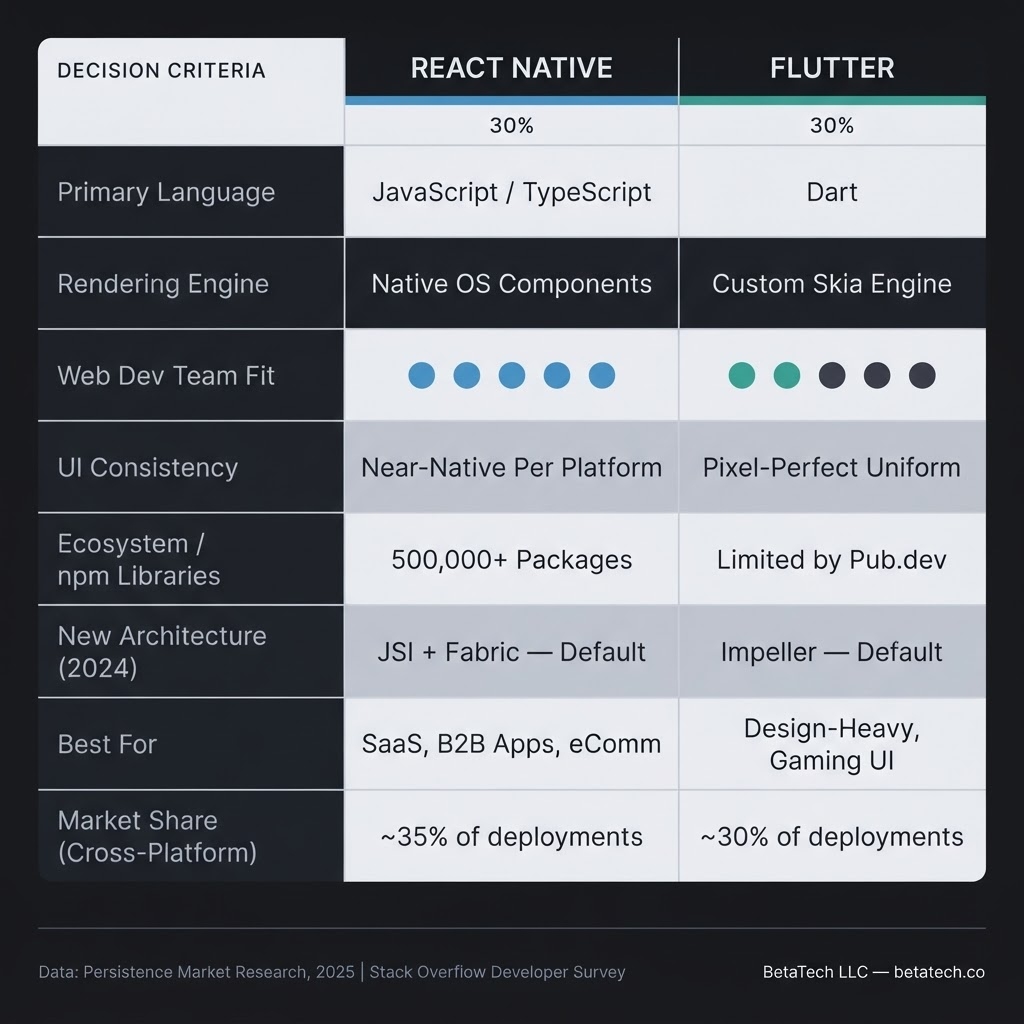
React Native is the right framework when your team already has JavaScript or TypeScript engineers, when your product roadmap includes a web counterpart (since React knowledge transfers directly), or when you need a mature ecosystem with deep third-party library support through npm’s 500,000+ packages.
The framework powers production apps at Microsoft (Office Mobile), Shopify (Shopify Mobile), and Meta (Facebook, Instagram) — at a scale that stress-tests the architecture in ways no demo environment can replicate. According to data cited by industry research, React Native accounts for approximately 35% of all cross-platform app deployments, with the broader cross-platform market projected to reach $124.5B in 2025 and $369.2B by 2032 at a 16.8% CAGR.
When Flutter Makes More Sense
Flutter’s Dart language and its own rendering engine (Impeller) give it a performance edge in pixel-perfect, graphically intensive applications where every frame counts — think gaming-adjacent UIs, complex animation systems, or apps requiring absolute visual consistency across every Android OEM skin. Flutter’s developer base is growing, but its JavaScript interop story for teams already working in React-based web stacks is a real friction point.
The honest answer most agencies won’t give you: for a standard B2B productivity app, SaaS companion app, or e-commerce mobile extension, React Native’s New Architecture closes the performance gap significantly, and its JavaScript ecosystem advantage is substantial.
Performance Standards: What to Demand Before You Sign
Performance in a mobile app is measurable. It is not a feeling. Any agency offering react native development services should be able to give you concrete performance benchmarks as part of their delivery specification — not after launch when rework is expensive.
App Launch Time
Cold start time (the time from app launch to interactive state on a clean start) should be under 2 seconds on mid-range Android hardware for a standard app without heavy local data processing. The React Native New Architecture’s Hermes engine — Meta’s optimized JavaScript engine — delivers significantly faster TTI (Time to Interactive) compared to legacy V8-based configurations, in part through bytecode precompilation at build time rather than JIT compilation at runtime. React Native 0.76 also demonstrated a median startup time reduction of approximately 15ms on Android through native library merging, reducing the binary count and load overhead.
Frame Rate and UI Responsiveness
Target 60fps for standard interactions, 120fps for devices supporting ProMotion displays (iPhone 13 Pro+, Pixel 7 Pro+). The Fabric renderer in the New Architecture handles UI updates synchronously on the main thread for time-sensitive interactions, which eliminates the ghost-touch and dropped frame issues that plagued the old bridge model.
Ask your agency: “What is your testing protocol for frame rate consistency across low-end Android devices?” Premium phones are not your users — mid-range Androids running Android 10 or 11 across Southeast Asia and Latin America are. If your agency only tests on flagship devices, their performance numbers mean nothing at scale.
Bundle Size and APK/IPA Optimization
Unoptimized React Native apps can ship with unnecessarily large JavaScript bundles. Metro Bundler — React Native’s default bundler — supports tree-shaking and code splitting, but only if the build pipeline is configured to use them. Ask for the target APK/AAB size before development starts. React Native 0.76 introduced native library merging that reduces Android app size by approximately 3.8MB (roughly 20% of total binary size) — an agency building on current versions should be delivering this benefit automatically.
Contract and IP Verification: The Clauses That Protect Your Business
The technical evaluation matters. But the contract is where most non-technical founders lose ground they never recover.
Code Ownership and IP Assignment
This is non-negotiable: your contract must contain an explicit intellectual property assignment clause that transfers full ownership of all source code, assets, and documentation to your company upon final payment. Some offshore agencies — not universally, but specifically those with predatory contract structures — retain a license over the codebase that prevents you from taking the work to another vendor without their sign-off. Read Section 7 (or equivalent) of any contract before anything else.
Codebase Portability
Verify that the deliverable includes the full source code in a repository under your organization’s GitHub or GitLab account — not the agency’s. Some vendors deliver a compiled build and retain the repository, creating a hostage dynamic where you pay for ongoing maintenance because switching vendors would require rebuilding from scratch. Insist on repository access from sprint one, not after final delivery.
Post-Launch Support SLA
An app is not a brochure. It requires OS compatibility updates, third-party API updates, security patches, and performance monitoring. Your contract should specify a post-launch support window — minimum 90 days — with defined response times for critical bugs (under 4 hours), major bugs (under 24 hours), and minor issues (under 72 hours). At BetaTech, our 24/7 continuous development cycle means our Bangladesh and US-based team structure covers all time zones without the overhead cost of a US-only agency running a single shift.
Source Code Documentation Standards
Ask for a code documentation standard commitment in writing. Undocumented code handed over at project completion is effectively locked code — even if you technically own it, no incoming developer can work with it efficiently without spending weeks reverse-engineering intent. JSDoc comments for all utility functions, a documented component library, and a README-driven project structure should be baseline expectations.
Evaluating an Agency’s Technical Team: What Signals Matter
Most agency websites display a team count and a list of logos. Neither tells you anything about the actual engineers who will touch your codebase.
Framework Depth vs. Framework Breadth
An agency that lists React Native, Flutter, Swift, Kotlin, Xamarin, Ionic, and PhoneGap as equal services has no genuine depth in any of them. Deep react native development services expertise is identifiable: the team should understand the JSI threading model, know how to write a custom TurboModule in both Java/Kotlin and Objective-C/Swift, and have an opinion on state management between Zustand, Jotai, and Redux Toolkit — not just “we use whatever the client wants.”
CI/CD Pipeline and Deployment Infrastructure
Production-grade mobile development requires automated testing and deployment pipelines. Ask whether the agency uses Fastlane, Bitrise, or GitHub Actions for automated builds and App Store / Play Store deployment. Ask about their test coverage standards — whether they write unit tests with Jest, integration tests with Detox, and whether end-to-end test suites run on every pull request or only manually before releases.
As noted in Google’s guidance on mobile performance and Core Web Vitals principles, the standard for user experience metrics is increasingly quantitative and expectation-driven — any production app should be instrumented with performance monitoring from launch day, not after users start complaining.
The Stack Around React Native
A mobile app does not exist in isolation. It connects to a backend API, consumes data from a database, handles authentication, and often integrates with third-party services. Verify that the agency can articulate the full-stack plan: what backend framework (Node.js/Express, Laravel, Django), what authentication protocol (OAuth 2.0, JWT with refresh token rotation), what database architecture (PostgreSQL with proper indexing, or MongoDB if document-oriented data fits the model), and how the API layer is versioned and documented. At BetaTech, our cross-functional team structure means the React Native developer, the backend developer, and the UI/UX designer are in the same project loop — not siloed handoffs that create integration gaps.
Understanding React Native Development Services Cost: US Market Reality
Cost transparency is one of the fastest ways to assess an agency’s integrity. Here is what the market actually looks like.
Rate Tiers and What They Signal
US-based React Native agencies typically bill between $150–$250/hour. Mid-market agencies with offshore delivery components (like BetaTech’s cross-functional model bridging Bangladesh and the US) operate in the $50–$100/hour effective range while maintaining direct English-language communication and US-timezone project management. Pure offshore-only shops quoting under $25/hour are cutting corners somewhere — on architecture, testing, documentation, or all three.
Project-based pricing for a standard MVP mobile app (authentication, core feature set, API integration, App Store submission) typically ranges from $18,000 to $55,000 depending on feature complexity, native module requirements, and backend infrastructure scope. Any fixed-price quote under $10,000 for a cross-platform production app from a credible agency should be investigated carefully.
Hidden Cost Vectors
Scope creep in mobile development often originates from underspecified API contracts between the mobile app and the backend. If your agency is building both, insist on API documentation (OpenAPI/Swagger spec) before a single frontend component is built. Every undocumented API endpoint is a future renegotiation point. Third-party service integration fees — push notification services, analytics SDKs like Mixpanel or Amplitude, payment processors, and map APIs — also accumulate quickly and should be scoped in the initial estimate.
Integration Ecosystem: What Your App Needs to Connect To
Modern react native development services don’t end at the app itself. The mobile application is the client layer of a larger system.
Backend API Architecture
The most common backend choices for React Native apps we build at BetaTech are Node.js with Express or Laravel (PHP) depending on the client’s existing infrastructure and team. GraphQL is increasingly common for apps with complex, relational data fetching requirements — it reduces over-fetching and enables precise data contracts between frontend and backend. REST remains the default for simpler, resource-oriented APIs.
For real-time features — chat, live notifications, collaborative editing — WebSocket connections managed through Socket.IO or native Firebase Realtime Database integrations are standard. The backend choice should be driven by the app’s data access patterns, not the agency’s technology preference.
Authentication and Security Architecture
Mobile security is a separate domain from web security, and most web-focused agencies underestimate it. JWT token storage on mobile devices should never use AsyncStorage in plain text — tokens must be stored in the Keychain (iOS) or EncryptedSharedPreferences (Android) via a library like react-native-keychain. Certificate pinning should be implemented for any app handling financial or health data to prevent man-in-the-middle attacks even on compromised networks.
The W3C’s Web Authentication specification (WebAuthn) provides the standard framework for biometric and hardware-key authentication flows that now extend into mobile via platform authenticators — an agency building a fintech or healthtech app should know this specification and its React Native implementation pathway.
Analytics, Crash Reporting, and Monitoring
Production-ready apps ship with instrumentation from day one: Firebase Crashlytics or Sentry for crash reporting, Mixpanel or Amplitude for behavioral analytics, and Datadog or New Relic for backend performance monitoring correlated with mobile events. An agency that doesn’t include observability tooling in their standard delivery is handing you an app you cannot diagnose when issues surface at 2am on a Tuesday.
Red Flags That End the Conversation
After reviewing hundreds of agency deliverables and proposal documents, these are the signals that consistently precede a bad engagement.
No architecture decision record in the proposal. If an agency sends you a timeline and a price without documenting why they are choosing React Native over Flutter, why they are structuring the backend a specific way, and how they will handle cross-platform divergence points, they are not engineering your solution — they are filling a template.
Portfolio with only screenshots. Live app links, Play Store listings, or App Store pages are verifiable. Screenshots are not. An agency that cannot direct you to a working production app they have shipped is showing you concept work, not delivered products.
Vague post-launch terms. “We’ll be available after launch” is not a support contract. Unclear maintenance terms are the primary source of post-delivery disputes between US clients and offshore agencies.
No version control access during development. Code that you cannot see being written is code you cannot own in practice, regardless of what the contract says.
Framework-agnostic answers to framework-specific questions. If you ask about JSI threading and the response is “we follow best practices,” the person answering doesn’t understand JSI threading. Push further.
What BetaTech’s React Native Development Approach Looks Like in Practice
At BetaTech, react native development services are not a standalone offering — they are embedded within a cross-functional delivery model that includes our UI/UX designer (Mahmudul Hasan), backend and WordPress architecture expertise (Sharmin Salma Tisha), and project coordination across both our Bangladesh and US operations (Miraj Ahmed).
Our 24/7 continuous development cycle is not a marketing phrase. It is the operational reality of a team distributed across time zones — it means our clients in the US go to sleep with an open sprint item and wake up to a completed pull request and a Loom walkthrough. No overtime billing. No “we’ll get to that Monday” delays. This is only possible with a cross-functional global team, and it is a structural advantage that a 2-person domestic freelance outfit or a bloated 50-person agency with three management layers physically cannot replicate.
We build on the React Native New Architecture by default. We deliver repositories under the client’s GitHub organization from sprint one. Our backend API contracts are written in OpenAPI spec before frontend development begins. We do not ship apps without Sentry integration, automated build pipelines via GitHub Actions, and at minimum a 90-day post-launch support window.
We also do not tell you we’re the best agency on the internet. There is no legitimate ranking system that makes that claim meaningful. What we tell you is: here is how we work, here is what you can verify, and here is how to hold us accountable.
Frequently Asked Questions
Q1: How much do react native development services typically cost for a US startup building an MVP?
A standard MVP — covering user authentication, a core feature set of 3–5 screens, API integration with a backend, and App Store/Play Store submission — typically ranges from $18,000 to $35,000 with a mid-market agency. That range assumes clear scoping, a documented API contract, and a 3–4 month timeline. Projects escalate beyond $50,000 when native hardware integrations (camera, Bluetooth, biometrics), real-time data features, or complex backend infrastructure are required. Any quote significantly below $10,000 for a production-ready cross-platform app deserves serious technical scrutiny.
Q2: What is the React Native New Architecture and why does it matter for my app?
The New Architecture replaces the legacy asynchronous JavaScript bridge with three core components: JSI (JavaScript Interface) for direct synchronous native calls, Fabric for a new concurrent UI rendering engine, and TurboModules for type-safe native module bindings generated at build time via Codegen. In practical terms, this means faster app startup, smoother UI interactions (particularly for gesture-driven experiences), and better memory management. As of React Native 0.76 (October 2024), the New Architecture is the default and production-recommended standard. If an agency is not building on it, your app starts life on a deprecated foundation.
Q3: How do I verify that the code an agency writes is actually mine after delivery?
First, ensure your contract contains an explicit IP assignment clause in plain English — not just a “work for hire” reference, which has jurisdictional variations. Second, insist on repository access from day one under your own GitHub or GitLab organization. Third, request a code handover checklist at project close that includes: source repository transfer confirmation, App Store / Play Store account access, all third-party API keys and credentials, environment variable documentation, and a deployment runbook. Anything delivered only as a compiled binary without source access should be rejected.
Q4: Can React Native apps handle the same features as fully native iOS or Android apps?
For the vast majority of business application use cases — yes. Authentication flows, push notifications, camera and photo library access, geolocation, payment processing, background data sync, Bluetooth connectivity, and biometric authentication are all well-supported through the React Native ecosystem and TurboModule-based native bridging. The edge cases where fully native development is genuinely superior are narrowing: they include apps requiring real-time computer vision processing, audio/video manipulation at the codec level, or AR/VR experiences that demand frame-perfect GPU control. For a SaaS app, e-commerce companion app, or B2B productivity tool, React Native handles the requirement set completely.
Q5: How long does a typical React Native app project take from kick-off to App Store launch?
A well-scoped MVP with a functional backend takes between 10 and 16 weeks under disciplined project management. Discovery and architecture (2 weeks), UI/UX design and client sign-off (2–3 weeks), frontend development in two-week sprints (4–6 weeks), backend API development in parallel (4–6 weeks), QA testing across device matrix (1–2 weeks), and App Store submission and review (1–2 weeks for Apple, 3–5 business days for Google). Timelines expand when scope is undefined at kick-off, design revisions are unlimited, or the client review cycle is unstructured. A 24/7 development cycle compresses these timelines by running development and design sprints in parallel across overlapping time zones.
Q6: Is React Native still the right choice in 2025–2026, or is it being replaced?
React Native is not being replaced — it is actively being invested in. Meta’s 2024 release of React Native 0.76 with the New Architecture as the default represents a multi-year architectural rebuild that has resolved the framework’s most-cited performance criticisms. The framework has 125,000+ GitHub stars, powers mission-critical apps at Microsoft and Shopify at enterprise scale, and its JavaScript/TypeScript foundation aligns directly with the web development ecosystem that most engineering teams already operate in. Flutter is a strong alternative for specific use cases, but the narrative that React Native is declining is not supported by adoption data or the trajectory of Meta’s engineering investment in it.
The Only Next Step That Makes Sense
You now have the technical framework to evaluate any agency offering react native development services. You know what architecture questions to ask, what contract clauses to verify, what performance benchmarks to demand, and what red flags end the conversation before it starts.
What you do with that information is the decision.
If you want to work with a team that builds on current architecture standards, delivers repositories under your ownership from sprint one, runs a genuine 24/7 development cycle across Bangladesh and the US, and has no interest in hiding technical decisions behind buzzwords — BetaTech is ready to talk specifics.
Not a sales call. A technical discovery conversation with engineers who will tell you exactly what your project requires, what it will cost, and what timeline is realistic based on your actual feature set.
Book a discovery call with BetaTech’s global expert team at betatech.co — and come with your hardest technical questions.